THE DANGERS OF PLASTIC PAINT
- Studio Wallander

- Sep 1, 2025
- 7 min read
Updated: Sep 2, 2025
JUST BECAUSE IT STICKS, DOESN'T MEAN IT BELONGS
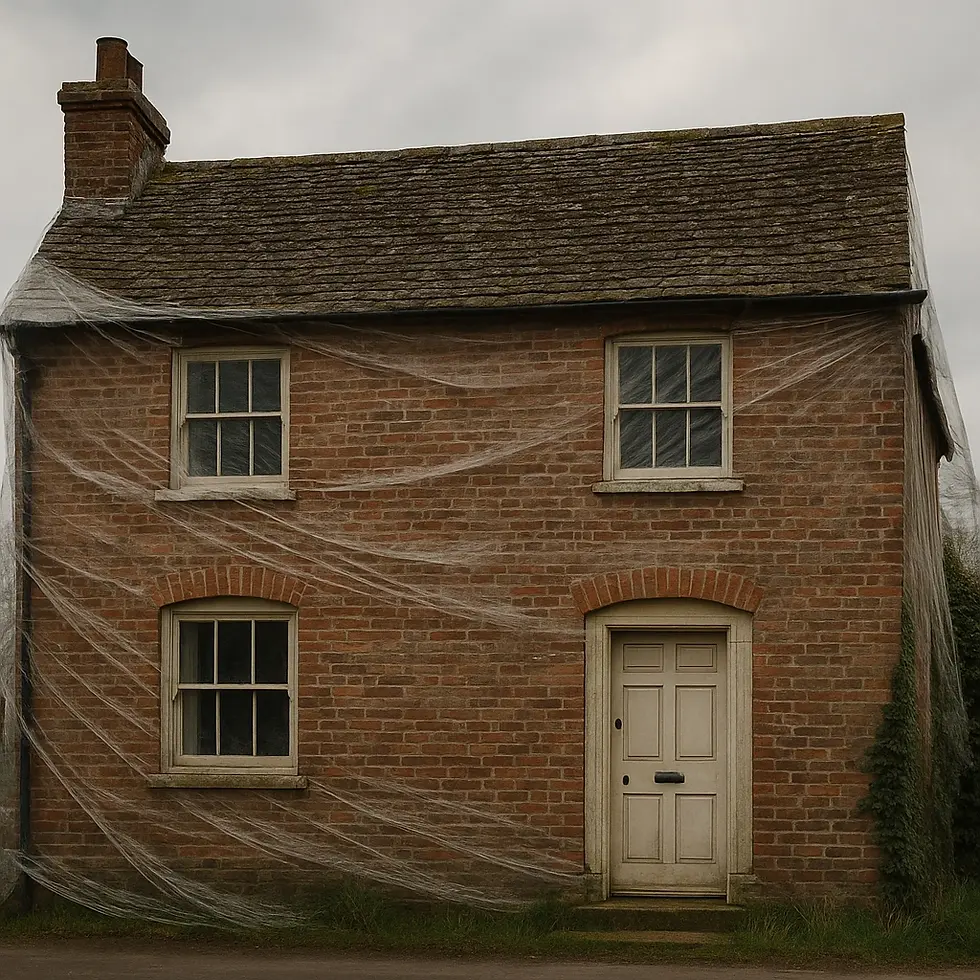
Suffocating in name, suffocating in deed
Plastic paint: the name alone feels cloying, like a flexible membrane which ensures no water comes in and no water goes out. In old houses, with walls of brick, or lath and plaster, what might seem like a quick, durable fix to problematic issues such as damp, it often turns out to be a problem in itself. Period walls and timbers live and breathe, and they shrink and sweat under the plastic cardigans we cover them with. Who wants to live among shrink-wrapped leftovers?
How is paint made?
Paint is a fascinating thing. It has the power to transform and cheer up a space, make it moody and dark, or give the feeling of endless sunshine. It is made, in its simplest form, by three things:
Pigment – the one that everybody talks about and which gets the most medals. Pigment is solid particles that give the paint its colour and opacity. Walls that look as if made of velvet, in which one thinks one can stick one’s whole arm, contain well-chosen, high-quality pigment. Historically these were earths or minerals. Today many paints use synthetic oxides or organic pigments: some vivid in colour, some less durable, and cheaper formulations cut back on pigment altogether, making paint look exactly that: cheap.
Binder (or resin) - the film-forming material that holds the pigment in place once the paint dries. Traditional binders: linseed oil, egg tempera, casein, lime. Modern binders: acrylic, vinyl, alkyd.
Solvent - the liquid that makes the paint spreadable. This liquid evaporates as the film dries and cures. In oil paints the solvent is turpentine or white spirit; in water-based paints, water carries the resin and pigment particles.
Additives (thickeners, dispersants, anti-foaming agents, fungicides) fine-tune the characteristics of the paint to be, for example, anti-mould paint for bathrooms.
Historic paint finishes
In pre-20th century paints, the binder was natural out of necessity: lime, casein, linseed oil, for instance. It dried by reacting with air or with the surface itself. Pigments were ground to a fine powder, often by skilled workmen (not yet by the ‘colourmen’ who in the later seventeenth century began to sell ready-prepared pigments to painters), and dispersed in the binder, with water or oil making it workable. Additives such as thickeners or preservatives are a 20th century development.
Limewash
Made from slaked lime and water
Highly breathable and antibacterial
Soaks into the surface rather than sitting on top
Soft, chalky appearance; evolves beautifully with age
Distemper
Mixture of chalk, water, and animal glue
Soft distemper was used internally for walls and ceilings, and also for plasterwork. It has a matte, powdery finish and marks easily.
Oil-bound distemper is slightly tougher, has less breathability and can harden with age.
There are two main types of distemper: soft distemper and oil-bound distemper. Soft distemper —a mixture of chalk, water, and animal glue —was used primarily for internal walls and ceilings. It has a delicate, powdery finish and can be wiped away easily, making it ideal for surfaces requiring regular refreshing, such as plaster mouldings. Oil-bound distemper includes oil as a binder, creating a more robust finish with limited breathability, better suited for areas needing a tougher surface. Historically, both lime wash and distemper were regularly recoated or entirely reapplied, which was part of their maintenance rhythm. Their durability lies not in longevity between coats, but in their compatibility with traditional construction and the ease with which they can be renewed.
Oil Paints
Developed for greater durability, particularly on woodwork and external surfaces
Made by mixing pigment with linseed oil
Produced a richer, slightly glossier finish
Oil-bound distemper is sometimes confused with true oil paint, but the two are quite different. Distemper is essentially a chalk-based coating bound with glue and a small amount of oil, suitable for internal walls but relatively fragile. Linseed oil paint, by contrast, contains no glue at all. It is made by grinding pigment directly into oil, producing a far richer, more durable finish. While both were used historically, oil-bound distemper was reserved for more delicate interior surfaces, whereas linseed oil paints were applied to woodwork, metal, and areas requiring greater longevity.
What is plastic paint?
Modern emulsions are usually based on vinyl or acrylic resins. Acrylic resins are synthetic polymers made by polymerising acrylic esters (such as methyl methacrylate, butyl acrylate). They are transparent, resistant to UV light, and water-resistant once cured: hence their use in everything from Plexiglas to adhesives to acrylic paints. They are useful and practical in many situations but do not fare well with old buildings.
Vinyl resins are tough and adhesive but can be less UV-resistant (they yellow easily) and are sometimes more prone to brittleness, particularly when exposed to sunlight.
Plastic paints replace the natural binder with synthetic polymer. Pigment particles are suspended in a liquid made of water and microscopic polymer spheres. As the paint dries, the water evaporates and the spheres fuse together into a continuous sheet of acrylic or vinyl plastic, locking the pigment inside. What remains on the wall is quite literally a film of plastic: flexible, washable, and much less vapour-permeable than historic finishes. If you have ever seen a wall where one can peel the paint off, it is often the sign of plastic paint.
These paints were designed during an era of industrial optimism (not unlike Victorian times) during the mid-20th century. They were hailed as the new, convenient way of using paints. Slap it on. Stand back and admire. DIY at its finest. They were able to create a smooth, impermeable film: hard-wearing, wipeable, marketed as progress. Compared to historic finishes, the difference is stark. Those older paints were soft, chalky, porous, they wore off under pressure. But to their credit, they allowed lime plaster and stone to release moisture, a vital exchange in houses built before cavity walls and damp-proof membranes.
So, why is this a problem in period homes?
Plastic paint prevents that vital exchange. It forms a barrier, trapping moisture inside walls. Instead of evaporating harmlessly, damp builds behind the sealed skin. The moisture has nowhere to go but to stay in the wall or take the path of least resistance: into the floor or the ceiling, escape round your windows, rot out any wood and weaken structures. The result: blistering paint, flaking plaster, patches of mould, soft wood. While, according to Historic England, as well as SPAB (Society for the Protection of Ancient Buildings), true rising damp is unusual, cases of inhibited moisture evaporation are not. The culprit might start as a leaking pipe, a blocked gutter, but the issue will be exacerbated by the inability to get rid of the offending moisture. What looked like ‘low maintenance’ in the tin turns into expensive repairs, because the house can no longer regulate itself.
The aesthetic crime
It is not only technical failure. Plastic paint is visually dead. Its surface is flat, plasticky, oddly uniform. Not unlike a photo by AI. Mouldings lose crispness and detail under thick layers. Soft distemper, which was often used for period details was meant to be wiped off and re-applied. Plastic paint is never removed. Layer after layer builds up until that fine profile of a cornice is all but rounded out and removed from sight. Timber grain is smothered. Light reflects poorly compared to the soft depth of limewash or distemper. What once had character and tactility becomes uniform, dull, lifeless. The very opposite of what old houses offer.
Compromise
There are better alternatives available today. Limewash, distemper, casein paints, mineral paints: all are vapour-permeable compared to modern acrylic emulsions, hence more breathable*. These finishes are, however, tricky to apply and often require professional application. As Patrick Baty notes in The Anatomy of Colour, limewash should not be used over previously painted surfaces, as it needs a bare, porous mineral base to work properly. These finishes can be intimidating and for clients who want to do their own painting, there is a plethora of ready-mixed colours. Farrow & Ball, Little Greene, Edward Bulmer and Mylands all offer paints that respect old walls. However, not all their paints are created equal. Do consult technical sheets and ask for advice before committing brush to wall.
Are all old paint formulas great? No. One could wish it were that simple. Old paints were no less poisonous than today. Today, if you choose carefully, you can find less harmful paints than back in the day. Old paints could contain lead, mercury, arsenic and many other undisclosed ingredients. If you are dealing with an old house and wish to strip paint, please assume that there is lead or other dangerous chemicals in the paint and take precautions. Even limewash, which only contains slaked lime and water, is caustic and can cause serious burns during application, both to skin and eyes. Just because something is natural, does not mean it is harmless. After all, arsenic is ‘natural’.
Don’t suffocate your home
Just because it sticks, does not mean it belongs. In period homes, plastic paint suffocates, literally and figuratively. A house smothered in plastic is sealed, silent, and could be slowly rotting from within. This is not what anybody wants for a house that has stood for longer than humans have known about plastics. All it takes is a little research, some time and a lot of patience, and we can do right by these old homes.
====================
* An aside on the term breathable. The word itself is unregulated in the UK: there is no legal definition of what counts as a ‘breathable’ paint. The measurable property is water-vapour diffusion, expressed as an Sd value under BS EN ISO 7783. The lower the Sd, the more vapour-permeable the finish. The standard defines three classes: V1 (high) below 0.14 m, V2 (medium) 0.14–1.4 m, and V3 (low) above 1.4 m. As a practical rule of thumb for old buildings, look for paints with an Sd value in the V1 class (below 0.14 m) and certainly no higher than about 0.5 m. One can find this information in the technical sheets from each paint company. If you can’t find it, do contact the company in question. If they will not release this information to you, it would be wise to avoid using them. If you are in any doubt regarding the suitability of any paint for your individual situation, please contact a professional.