THE VICTORIAN PARLOUR AT CHRISTMAS
- Studio Wallander

- Oct 23, 2025
- 4 min read
Updated: Oct 28, 2025
LIGHT, IVY AND A LITTLE THEATRICALITY
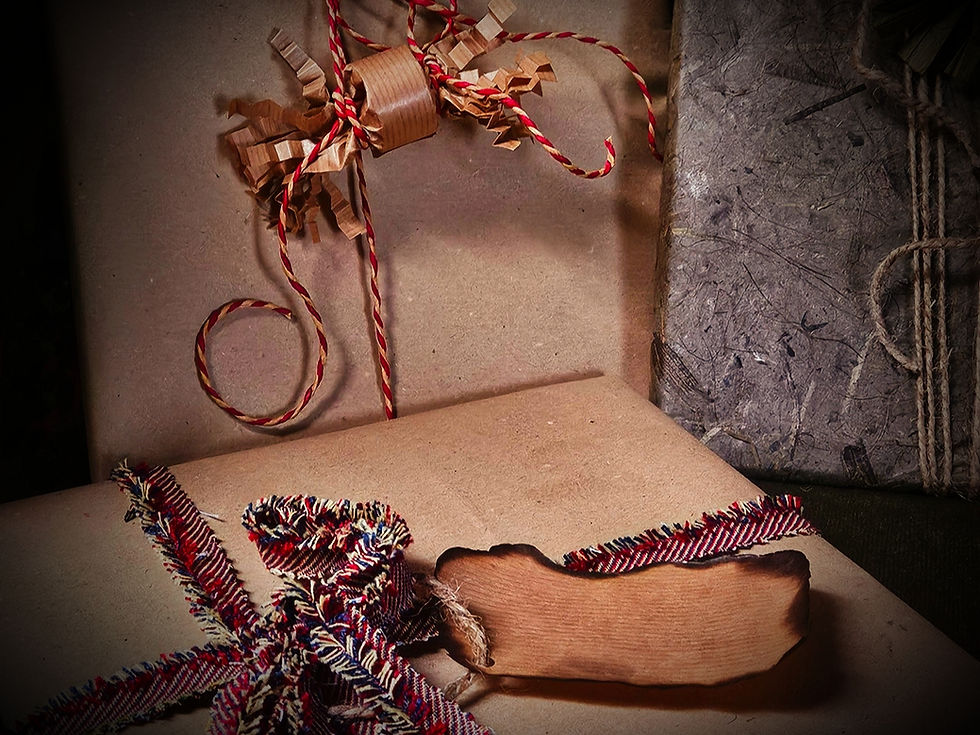
We all know the ideal Christmas: soft snow, minus 5 degrees (cold but not too cold), the morning starts with crisp sunlight, the darkness creeps in early but smoothly. One comes in from a day of cheerful shopping and socialising to congregate around an open fire with friends and good food, in an interior dressed in evergreens, candles and accompanied by the smell of cinnamon and oranges. The dream is most likely the same now as it was then. We dress our homes in the hope that this domestic theatre will enable our lives to become softer, warmer and happier than perhaps they truly are. The Victorian Parlour at Christmas is set as a stage for perfection.
Where does it all come from?
The need for warmth and softness is primal. Expression through the particular Christmas peculiarities that we can recognise as our traditions today appear around the middle of the 19th Century. Bringing greenery indoors was an old custom, but Dickens’s A Christmas Carol (1843) fixed the imagery of holly, mistletoe, and hearth-light in popular imagination, describing ‘the crisp leaves of holly, mistletoe, and ivy, reflected back the light, as if so many little mirrors had been scattered there.’
The Christmas tree on the other hand was a German nineteenth-century import. Prince Albert and Queen Victoria’s tree at Windsor Castle, pictured in the Illustrated London News of 23 December 1848, showed branches hung with paper roses, sweets, and lights, and this started the establishing of the practice in Britain. If it was good enough for the royals, it was good enough for all. As long as you possessed money, of course. Trees were expensive, and firs were not grown on a commercial scale as they are now. The custom spread top down. First through the fashionable elite and by the 1860s, the wealthier middle-classes had caught up. Shops supplied ready-made ornaments by this stage and for instance Covent Garden was known to sell trees. It was not, however, a universal feature. Only in the 1870s and 1880s did the custom spread more broadly, aided by department stores, florists, churches, and schools. An early version of welfare was communal trees hung with gifts for the children of the less fortunate. By the end of the century even modest homes might set up a small tree or branch, though holly and ivy remained the chief decorations for many.
Christmas Cards and Crackers
Henry Cole, a civil servant known for championing the penny post and The Great Exhibition in 1851, commissioned the first printed card of 1843. It was partly a practical invention since he found himself with too many letters to write, but also a ploy to help the Uniform Penny Post along. It took off and soon cards with imagery of ‘the perfect family Christmas’ were being delivered all over. Another very British Christmas tradition, the cracker, was invented in the 1840s by Tom Smith, a London confectioner who, inspired by French sweets wrapped in paper, added mottos and eventually the strip of chemically treated paper to make the exciting ‘bang’.
The Scent and Sound of Christmas
The parlour at Christmas was as much about scent as sight. The sharp green of holly and ivy mingled with the richer fragrance of oranges, which by the 1830s and 1840s were available through city grocers and had become a cherished seasonal treat (an orange in a stocking made a good gift). Spices long established in British kitchens: cinnamon, cloves, and nutmeg, imported through the East India trade, lent their warmth to puddings, mulled wine, and punch. The ancestor of the Christmas pudding as we know it, is the medieval ‘plum pottage’ or ‘plum porridge: a spiced beef and fruit stew. Over the 17th and 18th centuries it thickened into a boiled plum pudding. By the early 19th century, it had lost its meat and become more recognisable as the dense suet pudding with dried fruit, spices, and alcohol that we eat today. By the 1840s it was being called ‘Christmas pudding,’ boiled in a cloth or steamed in a basin, served flaming with brandy, and included in Mrs Beeton’s popular Book of Household Management (1861).
Parlour games (there is a reason for the name), and charades filled the evenings with laughter (one can hope), while carols and glees were sung around the piano. Many of the hymns we today recognise as Christmas hymns were collected or written during the 19th century, with William Sandys’ Christmas Carols, Ancient and Modern (1833) being the key collection. Dickens imagined such scenes in his Christmas tales, with bells, fiddles, and voices raised together. Even the steady crackle of the hearth and the occasional chime of church bells from outside contributed to the seasonal soundscape.
The Parlour as Stage
The parlour became the natural stage for these rituals. This was the room of display, of receiving company, of games and songs. Here the Christmas tree stood in pride of place, while garlands of holly and ivy wreathed mirrors and pictures. Ornament here was the same as during the rest of the year, not only decoration but a signal of hospitality and taste.
Light defined the atmosphere. Candles placed among the branches of trees shimmered dangerously but beautifully. The Victorians literally played with fire, while open fires and the growing use of gas added further glow. Gilt frames and mirrors doubled the effect, casting rooms into a shifting play of shadow and brilliance. At Christmas that principle was heightened: the room became luminous, and parlour competed with parlour to outdo each other.
Much of this persists and the Parlour, or simply our living room today stands ready for Christmas. Customs shift and fashions alter, but we still bring greenery indoors, still crown the door with a wreath, still hang lights against the darkness. The branch of mistle toe under which some of us might steal a kiss, descends from Victorian elaborate kissing boughs, and while electric strands have replaced candles on the tree, the craving for glow, shimmer and warmth remains. The greenery and light, the room staged for company and cheer, give the same promise they always have: whatever else changes, the house at Christmas can be timeless.
... and it was always said of him, that he knew how to keep Christmas well, if any man alive possessed the knowledge. May that be truly said of us, and all of us! And so, as Tiny Tim observed, God bless Us, Every One!
Charles Dickens, A Christmas Carol.