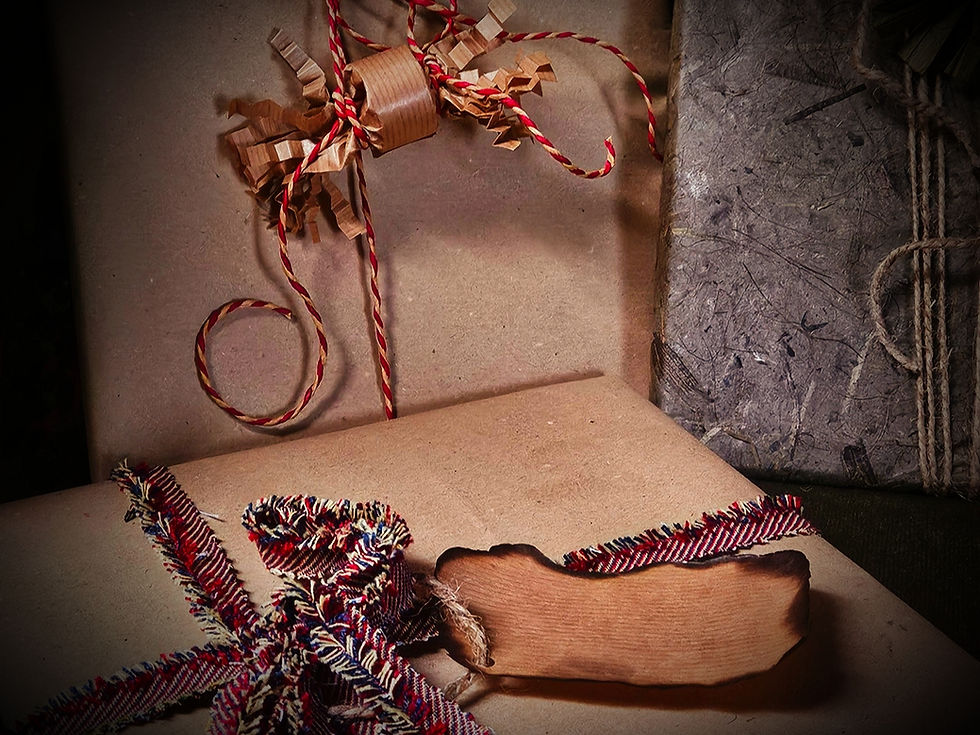
DECORATING FOR CHRISTMAS
- Studio Wallander

- Nov 30, 2025
- 8 min read
Updated: Dec 1, 2025
THE ANNUAL CHRISTMAS PANIC

Don’t you think we ought to....?
There is something about December that makes even the most sensible people behave strangely inside their own homes. A house that has been quietly minding its business for eleven months suddenly becomes the scene of frantic reinvention. The annual decorating race for the holidays has arrived. Paint testers appear on walls like outbreaks. Rugs are dragged back and forth in a state of mild desperation. Fairy lights proliferate. Delivery drivers develop a haunted look as yet another parcel is ordered ‘just in case’. Food is bought that nobody eats (or truly enjoys) at any other time of the year. How many chocolates filled with liqueur sit abandoned in cheap looking but wanting to be expensive boxes at the end of the festive season? For some reason, the moment the calendar turns to the first of the month, people begin to believe that the house must be transformed, perfected, polished, and ready for inspection. And all in time before the mother-in-law and the grumpy uncle arrive. As if they are specialists in interiors.
The irony is obvious. Visitors would be far happier with a warm drink, a comfortable chair and the sense of less stress indoors than outdoors, than they would be with emergency wallpapering. Yet year after year, houses everywhere endure a strange, festive urgency that they neither asked for nor enjoy. Older houses, in particular, resist this sort of sudden tampering. They are slow creatures. They respond to steady, thoughtful changes, not to mid-winter acts of sacrifice and panic.
The sudden December decorating instinct usually begins with a thought which is then often spoken out loud after dinner: ‘We ought to do something about this room before Christmas. Don’t you think it could do with some freshening up before people arrive?’ ‘Something’ is never truly defined, but it quickly balloons into ‘everything’. A coat of paint becomes a total re-think of the colour scheme. A tired sofa becomes a wish for a new layout. A slightly wonky curtain pole becomes an entire discourse on window treatments. Before long, the whole house is implicated, and the sentence is often harsh.
The temptation to hurry is understandable. Christmas magnifies whatever is already unsettling you about a room, and dare I say it, about your life. Christmas should be perfect since if it is not, your life might be lacking. The furniture arrangement that has been tolerable since March suddenly feels wrong when you imagine six people navigating around it with drinks in hand. A hallway that merely seemed dull in October becomes, in December, an embarrassment requiring immediate action. Even the carpet that you hardly notice on an ordinary Tuesday becomes a source of shame once you imagine your in-laws walking across it.
But this is the moment to pause. Many mistakes in older houses are made in haste. Rushed decisions are almost always poor ones. A last-minute paint colour chosen under artificial light rarely looks as intended. A sofa bought in a panic will be the thing you quietly resent until next Christmas, when it might get changed during yet another decorating frenzy. Fairy lights taped to a Regency cornice will be remembered by the plaster for far longer than the season lasts.
Slow down
Old houses do not reward speed. They need observation and careful thinking. The best results come from understanding the house’s own rhythms: how cool winter light falls at four in the afternoon, which corners feel naturally cosy, how the rain taps on the window, which pieces of furniture already carry weight, which ornaments feel at home, and which look out of place, like the reproduction Meissen porcelain shepherdess handed down from your relatives. These are not revelations that come from frantic activity. They arrive when we slow down.
Quick wins
That said, there are a few things that can genuinely be improved in the short term without distressing the fabric of the house. Lamps, for one. Most rooms benefit from two or three extra pockets of glow, especially in December when daylight is brief. Do not be afraid of adding more lamps than you think are necessary. Keep your light bulbs warm. For Christmas, 2200 to 2500 Kelvin mimics candlelight and is perfect for the season. Real candles are obviously the cosiest of lights, but needless to say, not safe around children or pets. Consider battery-driven candles with real wax shells. Rearranging furniture to create more comfortable circulation for guests can make sense, provided you resist the urge to redesign the entire room. Creating space to move around can make a great difference for elderly people, and might make it easier to grab hold of the arm of a chair or the end of a sofa to get up. Removing delicate rugs can save them from the onslaught of shoes, whilst adding sturdy rugs and door mats in the hallway is an easy way of stopping dirt and slush being tracked through the house. If there is space, a fully decorated tree screams Christmas more than anything. However, the longer one lives in the world, the greater the oddness seems of growing trees only to chop them down, bring them in the house, hang them with decorations, hope they won’t die too soon and release a dirge of needles on your carpet, and then throw them on a rubbish heap come January. The sight of brown, dry tree skeletons abandoned by the road in the flat light of new year is a truly sad sight. A seasonal branch hung with modest decorations or a simple string of ivy can be equally beautiful, not damage any trees and if you are lucky enough to have a garden, they can be collected on a crisp winter’s morning, which is a delight in itself. None of these warrants panic.
Fewer plastic avocados
One of the great misunderstandings of Christmas decorating is the belief that more is more. More bows, more plastic avocados with gold string to hang, well anywhere, more garlands, more lit-up inflatable reindeers, more anything. Houses rarely improve with tasteless excess. Older houses, particularly Georgian and Victorian ones, are already ornamental whether they intend to be or not. Their plasterwork, joinery, floorboards, and proportions hold their own interest. Overloading them with baubles and tinsel often creates an unintended competition between the house and the season. The only thing I would advocate for in excess are lights. Soft, warm lights will make a house glow with a welcoming sense that nothing else really can create. If you do nothing else, light your house.
Whether you are a maximalist or a minimalist, the fact is that a bowl of fresh winter fruit on a hall table, a real garland framing a doorway, a single large candle on a mantelpiece or a festively coloured tablecloth can support the Christmas feeling without going overboard. If you choose to decorate more heavily, concentrate on one or two areas to emphasise and leave the rest of the room to breathe. A house needs its quiet spaces in December as much as its festive ones. The mantel, staircase or the front door are the obvious places to go big.
To faux or not to faux Let's deal with the elephant in the room. Likely you fall into one camp or the other - camp faux or camp real. To be honest, one foot in each is probably the most practical take on this important question. Choosing fake greenery makes life simple. It won't wither or die, nor will it change year upon year. However, if you do go down the fakery route, make it good. No cheap, foul smelling plastic that smells like petrol. Spend the money on real feel, good looking garlands and tree, and keep them for years. Once you have acquired the necessary items, there will be no need to buy more (unless you move or you feel the need for a Home Alone kind of Christmas). This is the way to go if you like decorating but will stop short of dragging trees home, sticking out of your car boot.
If you cannot imagine a Christmas without a real tree, all I can say is: Nordmann Fir. There really is no alternative for a tree that holds its needles, looks full and round, and has glossy dark green needles. It will stay alive for a very long time so if you love to start early, you can buy it in November and as long you remember to water it, it will still be going strong at Christmas.
Make sure that you look through the branches and if you can, lift the tree up and drop it down on its trunk when choosing. Doing this will make sure any insects etc. lose their grip and will not come home with you. If a lot of needles fall off, walk away. If something larger and alive falls out, run away.
Can you smell that?
Then there is the matter of scent. At some point, Christmas became an olfactory battleground. Pine, cinnamon, cloves, fir needles, orange, mulled wine, gingerbread. Hopefully real, but mostly synthetic. All scents equally valid as Christmas smells, but all competing for dominance. A single candle can be charming. Six competing scented diffusers create an experience that can only be described as chaos. An older house already carries its own winter smells: wood, wool, draughts, cold air, the unmistakable smell of burning logs. All are part of the deal. Adding one, carefully chosen scent can enhance them. Adding five simply creates confusion.
The real bugbear of Christmas decorating, and the one that almost no one cares to admit to having at the forefront of their minds, is that people decorate frantically because they are anxious about being judged. In-laws, friends, colleagues, neighbours: someone might come over and form an opinion. Even worse, they might tell somebody else about that opinion. That fear is what drives the impulse to ‘fix’ rooms that were perfectly acceptable in November. But the best Christmas interiors are not the ones that are flawless. They are the ones that feel lived-in, warm, coherent, welcoming, and comfortable. A room with a few scuffs and a well-placed lamp is more welcoming than a room freshly painted in haste, and the sofa pushed across the room at 3am.
A tidy house If you want to do something genuinely worthwhile before Christmas, consider editing rather than adding. Remove the visual noise rather than redecorate. Declutter and clear surfaces that have gathered old letters, rubber bands, and odd bits and bobs throughout the year. Put away the window cleaner you meant to use last spring but never got around to. Polish the brass you already have. Straighten the pictures. Dust a little. Replace the bulb you have been meaning to change since summer. Put a rug straight. Clean the bathroom. Hang a tiny sprig of mistle toe. All of this requires far less effort than a last-minute redecoration, and yet the effect is far more noticeable to guests since you will open the door calmly.
Christmas does not require a complete and potentially traumatic transformation. A house that feels loved and cared for in small, thoughtful ways all year round is far more inviting than a house that has clearly been decorated in a fit of seasonal fright. Older houses especially prefer gentler gestures. They have seen many winters, many gatherings, many Decembers. This one is not special because every year is special. They do not need rescuing just because the cousin who lives in America is coming over for the first time in ten years.
The most successful Christmas rooms are not the ones in magazines, nor the ones designed to impress an audience. They are the ones that allow the season to sit alongside the house rather than on top of it. A little greenery, a little warmth, a few points of light, something fragrant but not insistent, enough to acknowledge the time of year without forcing the house into a costume it never chose.
If you find yourself tempted to overhaul the house this month, pause. Look around. Breathe. You can be house proud, you can make it beautiful, your house can be the belle of the ball even if it wears the dress from last year. Christmas is not about how impressed others are with you and your house. It is about how welcome they feel, how much laughter there is, and how lightly this Christmas rests on everybody’s shoulders.
The house is already doing most of the work. It simply needs you to avoid undoing it in the rush of December.
And with that, I wish you the merriest of Christmases.